I was a member of the Youth Choir for my Church and sang at a significant number of funeral Masses, including those for our military who died in Vietnam. Standing there in song while families grieved left a lasting imprint on me. I had the opportunity to speak to many returning combat veterans at local funeral parlors about the War in Vietnam, and their accounts carried a weight I had never heard before. Their stories differed widely from the noncombat WWII high jinks my father and his brothers shared over our holiday table; these were quieter, heavier stories, marked by loss, duty, and memories that did not fade easily.
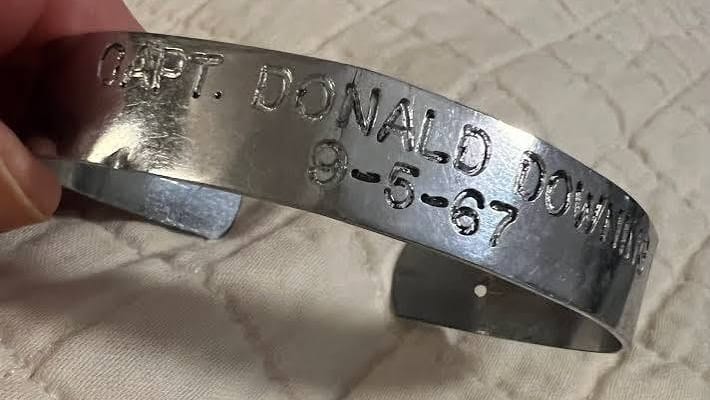
The Summer of 1970, I travelled to California to attend a cousin's wedding. That was also when I was introduced to a student-led organization called "Voices in Vital America (VIVA)." I purchased a POW-MIA bracelet, a simple band engraved with the service-member's name, rank, and date of capture or loss. Wearing it made the war feel deeply personal; the name on that bracelet was no longer an abstract casualty of a distant conflict, but a human life I carried with me every day. This was when my veteran's advocacy had its official beginning.
Wearing the bracelet proved more challenging than I expected. To me, it was a promise: a small, constant act of remembrance for someone whose fate was unknown. But my father saw it differently. He believed it symbolized the anti-war movement, and no matter how carefully I explained myself, he would not accept that the college students who began "VIVA" wanted to support the troops and bring attention to the growing plight of POW-MIAs without joining the demonstrations that villainized those who were serving. That misunderstanding stung, because the bracelet was not a protest against our military; it was my way of refusing to let the missing be forgotten.
I became a Brooklyn liaison of sorts, eager to share my conviction about the bracelets with anyone who would listen. As a reporter for my high school paper, I believed I had the perfect platform to tell my classmates about the isolation endured by our troops and the reported mistreatment of those held captive. I wanted their names spoken, their suffering acknowledged, and their service understood. Unfortunately, some members of the school administration shared my father's jaundiced view of VIVA and did not think the Vietnam War was a proper subject for student journalism. Their preferences leaned toward safer distractions—pet rocks, limited television fare, and anything that did not force young people to confront the moral turbulence of the day. Certainly not the war, and certainly not episodes of "All in the Family" where adult children openly criticized the government.
Meanwhile, I quietly procured and distributed POW bracelets and wrote letters to the troops overseas. Each bracelet felt like a name rescued from silence; each letter, however small, felt like a thread of human connection stretched across an ocean and into a war zone. Greenwich Village in Manhattan became my political touchstone. It was there that I learned about Vietnam Veterans Against the War, and there that I watched young men in fatigues pour out their hearts to students, tourists, strangers, and even to me. Their words were raw, unvarnished, and impossible to forget. They were not speaking in slogans; they were speaking from wounds.
It was a time of heightened confusion, punctuated by suspicion, anger, and grief. Yet somewhere in that confusion, I began to understand that remembrance is not passive. It asks something of us. It asks us to listen when the stories are painful, to speak when silence is easier, and to carry a name until that name is finally brought home.